Contour and Detail Survey Explained | Perth Surveying

Contour and Detail Survey Explained
Before your designer can plan a new home, extension, renovation, subdivision, granny flat, pool or outdoor area, they need accurate site information to work from.
That is where a contour and detail survey gives your project the right starting point.
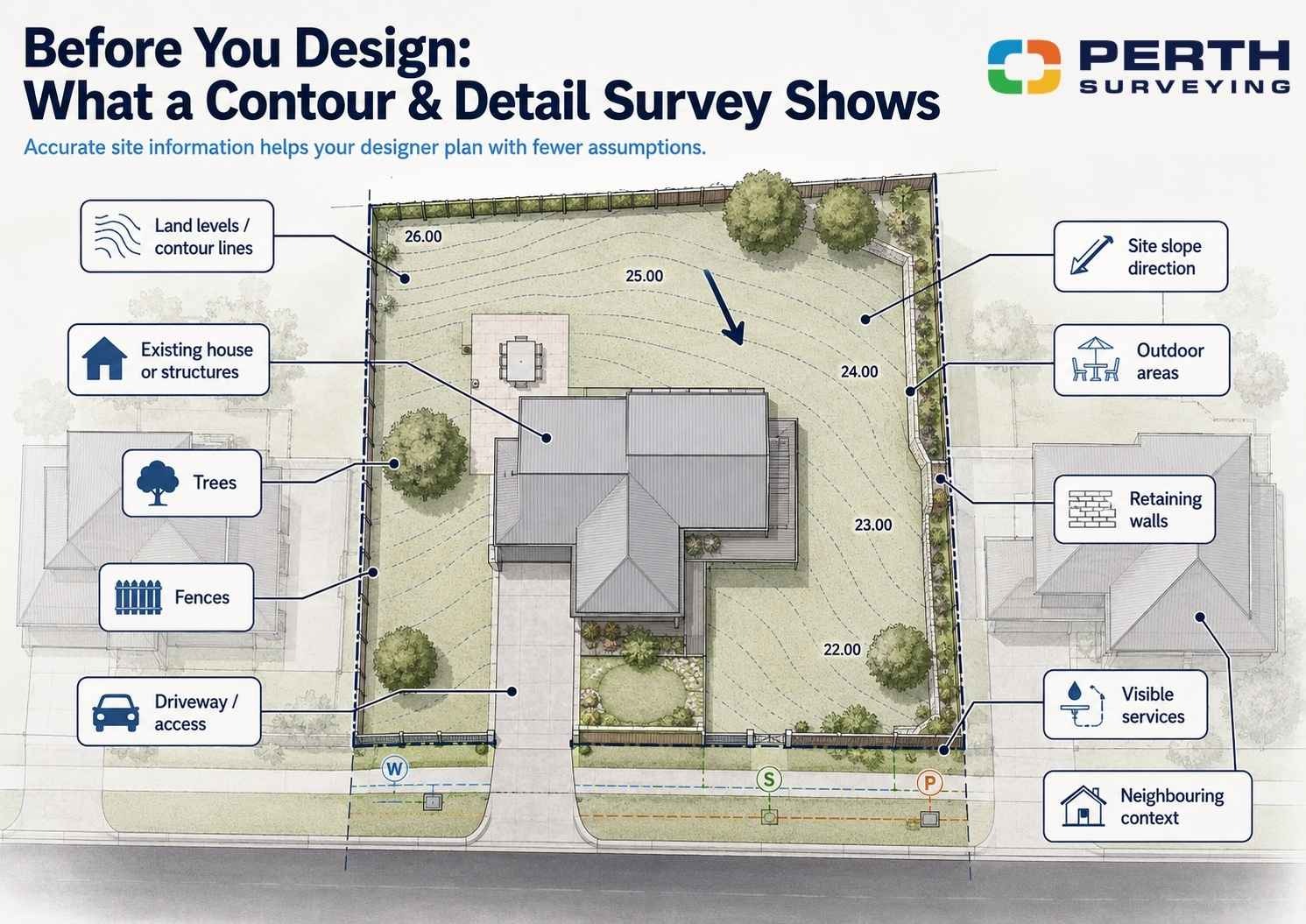
A contour and detail survey gives your designer a clear picture of the site before planning starts. It shows the land levels, visible site features, existing structures, services, fences, trees, retaining walls, and surrounding context that may affect the design.
Many property owners start by searching for a land surveyor in Perth after their designer, architect, builder or planning consultant asks for a site survey. In many cases, the survey they need is a contour and detail survey.
At Perth Surveying, we prepare clear, accurate survey plans that help designers, builders, developers, and property owners start with the right information from day one. The goal is simple: give your designer accurate site information so your project can move forward with fewer delays and fewer assumptions.
Why Designers Need a Survey Before Planning Starts
Designers need accurate site information before they can prepare plans that suit the actual block.
Every block has its own conditions. Some sites slope from front to back. Others slope from side to side. Some have retaining walls, old structures, drainage issues, trees, narrow access, or neighbouring buildings that influence what can be designed.
Without a contour and detail survey, your designer may have to make assumptions about levels, access, drainage, existing structures, and surrounding site conditions. Those assumptions can create costly problems later.
A design that looks good on paper may not suit the real site levels. A driveway may be too steep. A finished floor level may not work with the surrounding ground. Retaining requirements may be underestimated. Drainage may not be properly considered. Existing structures or nearby features may be missed.
A contour and detail survey helps reduce those risks.
How the Survey Gives Your Designer the Right Starting Point
The survey acts as the base plan for the design. It gives the designer the information they need to position the proposed building or work properly.
This can help with:
- Building placement
- Finished floor levels
- Driveway design
- Drainage planning
- Retaining wall planning
- Outdoor area design
- Site access
- Planning approval drawings
- Engineering coordination
- Builder pricing and construction planning
When the survey is completed early, your designer can respond to the real site conditions from the beginning, rather than revising plans after issues appear.
What Can Go Wrong Without a Survey?
Skipping the survey may feel like a shortcut early on, but it can create design changes, delays, and unexpected costs later.
A designer may still be able to prepare a rough concept without a survey. However, once accurate site information becomes available, that concept may need to change.
For property owners, this can mean delays, extra design fees, approval complications, or unexpected construction costs.
Common problems include:
- Plans need to be redrawn after site levels are confirmed
- Driveways that do not work with the actual slope
- Retaining walls being added later
- Drainage issues being discovered too late
- Building heights needing adjustment
- Outdoor areas that do not connect properly to the house
- Boundary assumptions creating design problems
- Missed services or site features
- Builders needing to reprice the work
- Construction delays caused by incomplete information
The earlier the survey is completed, the easier it is to design properly and avoid rework.
A contour and detail survey will not remove every project risk, but it gives your team the accurate information needed to make better decisions from the start.
When Should You Book a Land Surveyor in Perth?
In most cases, you should book a land surveyor before detailed design work begins.
If you are working with a designer, architect, builder, planner, engineer, or draftsperson, they may ask you to organise a contour and detail survey before they prepare drawings.
This is a standard early step in the design process. It ensures your consultant has accurate site information before preparing detailed plans.
You may need a contour and detail survey before:
- Designing a new home
- Planning a renovation
- Planning an extension
- Designing a granny flat
- Building a shed or outbuilding
- Installing a pool
- Designing landscaping or retaining walls
- Planning a subdivision
- Preparing development approval drawings
- Requesting accurate builder pricing
- Starting engineering design
If you are unsure what type of survey you need, Perth Surveying can help clarify the right survey for your project.
Contour and Detail Survey vs Boundary Survey: What’s the Difference?
No. A contour and detail survey and a boundary survey are different, although they can both be important.
A contour and detail survey records the physical features and levels of the site. It helps with design and planning.
A boundary survey identifies the legal boundaries of the property. It confirms where the title boundaries are located.
Contour and detail survey
A contour and detail survey is used for design and planning. It shows site levels, existing structures, visible features, and surrounding details.
Boundary survey
A boundary survey confirms the legal property boundaries and may be required when building near a boundary, replacing fences, resolving boundary questions, or planning a subdivision.
Do you need both?
Sometimes, yes.
For example, if you are designing a new home close to a side boundary, your designer may need site levels and features, while your builder or consultant may also need boundary information confirmed.
If you are planning a subdivision, boundary information is often especially important.
A licensed surveyor can advise whether your project needs a boundary survey, a contour and detail survey, or both.

Why Site Levels Matter in Residential Design
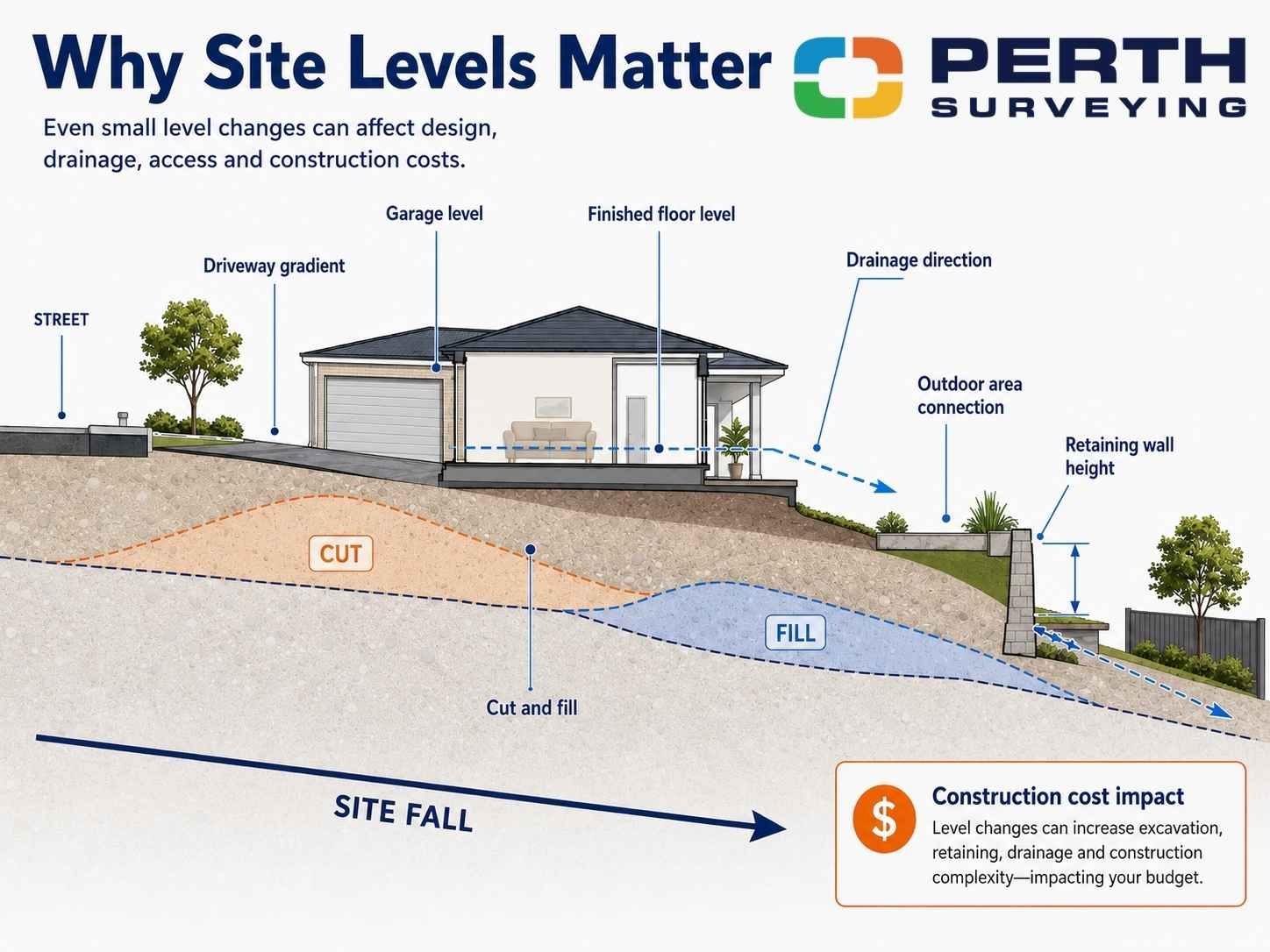
Site levels are one of the most important parts of a contour and detail survey because they affect how the design will actually work on the block.
They show how the land changes across the property, which can affect floor levels, access, drainage, retaining, and construction costs.
Even a small level change can affect design, drainage, access, retaining and construction costs. It can affect the height of the house, the amount of earthworks required, the need for retaining walls, how stormwater drains, and whether access is practical.
Site levels can influence:
- Finished floor levels
- Garage levels
- Driveway gradients
- Retaining wall height
- Drainage direction
- Cut and fill requirements
- Outdoor living areas
- Steps, ramps, and access
- Site costs
- Construction complexity
For example, if a block slopes down from the street, the designer needs to understand how the garage, driveway, and house levels will work together.
If a block slopes toward a neighbour, drainage needs careful consideration.
If a backyard has significant level changes, a proposed patio, pool, or extension may need retaining walls, steps, or adjusted levels.
Good design starts with understanding the land.
What Does a Designer Do With the Survey?
Once the survey is complete, your designer can use it as the base plan for the project.
The survey can be used as a base plan in design software, allowing proposed works to be drawn over accurate existing site information.
This allows the designer to see how the new design relates to the current land, buildings, boundaries, levels, and surrounding features.
Designers use the survey to:
- Position the proposed building or structure
- Set appropriate floor levels
- Plan vehicle and pedestrian access
- Understand site constraints
- Coordinate with engineers
- Design around trees, retaining walls, and existing structures
- Prepare planning or building approval drawings
- Reduce the risk of design changes later
- Help the builder understand the site before pricing or construction
The survey is also useful beyond the design stage. It can be useful for the whole project team.
Builders, engineers, planners, certifiers, pool companies, landscapers, and other consultants may all refer to it during the project.
Who Needs a Contour and Detail Survey?
A contour and detail survey is commonly needed by homeowners, designers, builders, developers, and trade contractors.
The type of project will determine the level of detail required.
Homeowners
Homeowners often need a survey before planning a renovation, extension, new home, granny flat, pool, or outdoor upgrade.
Many homeowners have never ordered a survey before, and that is completely normal. Your designer may simply tell you, “We need a contour survey before we can start.”
Perth Surveying can explain what is involved, what information is needed and how to get the survey booked.
Designers and architects
Designers and architects need accurate survey plans so they can prepare designs that suit the actual site.
A clear survey helps reduce guesswork and makes it easier to coordinate with other consultants.
Builders
Builders rely on accurate information to price and plan projects properly.
A good survey can help builders understand site access, levels, existing features, and potential construction constraints before work begins.
Developers
Developers may need contour and detail surveys to assess feasibility, lot layout, access, drainage, and site constraints.
For subdivision and development work, early survey information can support better planning decisions.
Trade partners
Pool builders, landscapers, shed companies, granny flat builders, and other residential trade partners often need accurate site levels and features before they can design or quote properly.
How Perth Surveying Helps Projects Start Properly
When people search for a land surveyor in Perth, they are usually looking for more than measurements. They need clear advice, reliable scheduling, and a survey plan their project team can use with confidence.
They want someone who can respond quickly, communicate clearly, attend the site when agreed, and provide a plan that the designer can use with confidence.
Perth Surveying focuses on reliable scheduling, fast turnaround, clear communication and high-quality survey plans that your project team can use with confidence.
That matters because delays at the survey stage can slow the whole project down.
If the designer is waiting on survey information, they may not be able to start or complete the drawings. If the drawings are delayed, approvals, pricing, and construction can also be delayed.
With Perth Surveying, you can expect:
- Clear guidance on the survey you need
- Reliable booking and scheduling
- Fast turnaround
- Accurate site information
- Clear survey plans
- Local WA knowledge
- Communication that keeps the next step clear
Perth Surveying works with homeowners, builders, designers, architects, developers, and trade partners across Perth Metro and broader WA.
The focus is always the same: clear survey information, reliable turnaround, and confidence for the next stage of the project.
Conclusion
A contour and detail survey gives your designer the accurate site information they need before planning starts.
It shows the land levels, site features, existing structures, visible services, retaining walls, fences, trees, and surrounding details that may affect the design.
Without this information, your designer may be forced to make assumptions. That can lead to design changes, approval delays, drainage issues, construction problems, and unnecessary rework.
Whether you are planning a new home, renovation, extension, subdivision, granny flat, pool, shed, or landscaping project, booking the right survey early is one of the smartest steps you can take.
Need a reliable land surveyor in Perth?
Contact Perth Surveying to request a quote and give your designer accurate site information from day one.
Call 08 9303 2407
Email admin@perthsurveying.com.au
Visit perthsurveying.com.au
FAQs
How long does a contour and detail survey take?
The time required depends on the property size, site conditions, access, and the level of detail required. Perth Surveying can confirm expected scheduling and turnaround when you request a quote.
Do I need a licensed surveyor for a contour and detail survey?
A professional surveyor can prepare a contour and detail survey. If your project involves legal boundary definition, boundary marking, subdivision, or title-related work, a licensed surveyor may be required. If your project also requires legal boundary definition, subdivision work, or boundary marking, a licensed surveyor may be required.
Can my designer arrange the survey for me?
Yes. Some designers arrange surveys on behalf of their clients. You can also contact Perth Surveying directly and provide your designer’s details so the completed survey is prepared with their requirements in mind.
How much does a contour and detail survey cost in Perth?
The cost depends on the property size, location, site conditions, access and level of detail required. Perth Surveying can provide a quote once we understand your project and survey requirements.
