Perth R-Code Density Reforms and What Changes Next
What Perth’s R-Code Changes Could Mean for Your Neighbourhood
The WA Government has announced proposed R-Code reforms that could influence how some residential land is assessed, subdivided and developed across established Perth suburbs. The changes are part of a broader push to support gentle density, improve housing choice near transport and shopping hubs, and help Perth move closer to its long-term infill targets.
For families, homeowners and residents, the announcement raises a practical question. What could these changes mean for your street, your property and future housing options in your neighbourhood?
For many Perth residents, density raises practical concerns. It raises fair questions about traffic, parking, school catchments, street character, and whether familiar neighbourhoods will still feel familiar in years to come. Those concerns are valid. When change is happening close to home, people want clear information and a practical understanding of what it could mean.
The proposed R-Code overhaul is best understood as a shift toward gentle, better-located growth. Rather than pushing every new home to the outer edge of the city, the reforms aim to make room for more housing choices in established suburbs, especially near transport, shopping areas, and existing community services.
This guide explains what the changes could mean at a neighbourhood level. It is written for families, residents, and anyone who wants to understand the direction Perth is heading before public consultation opens later in 2026.
What Are R-Codes and Why Do They Matter?
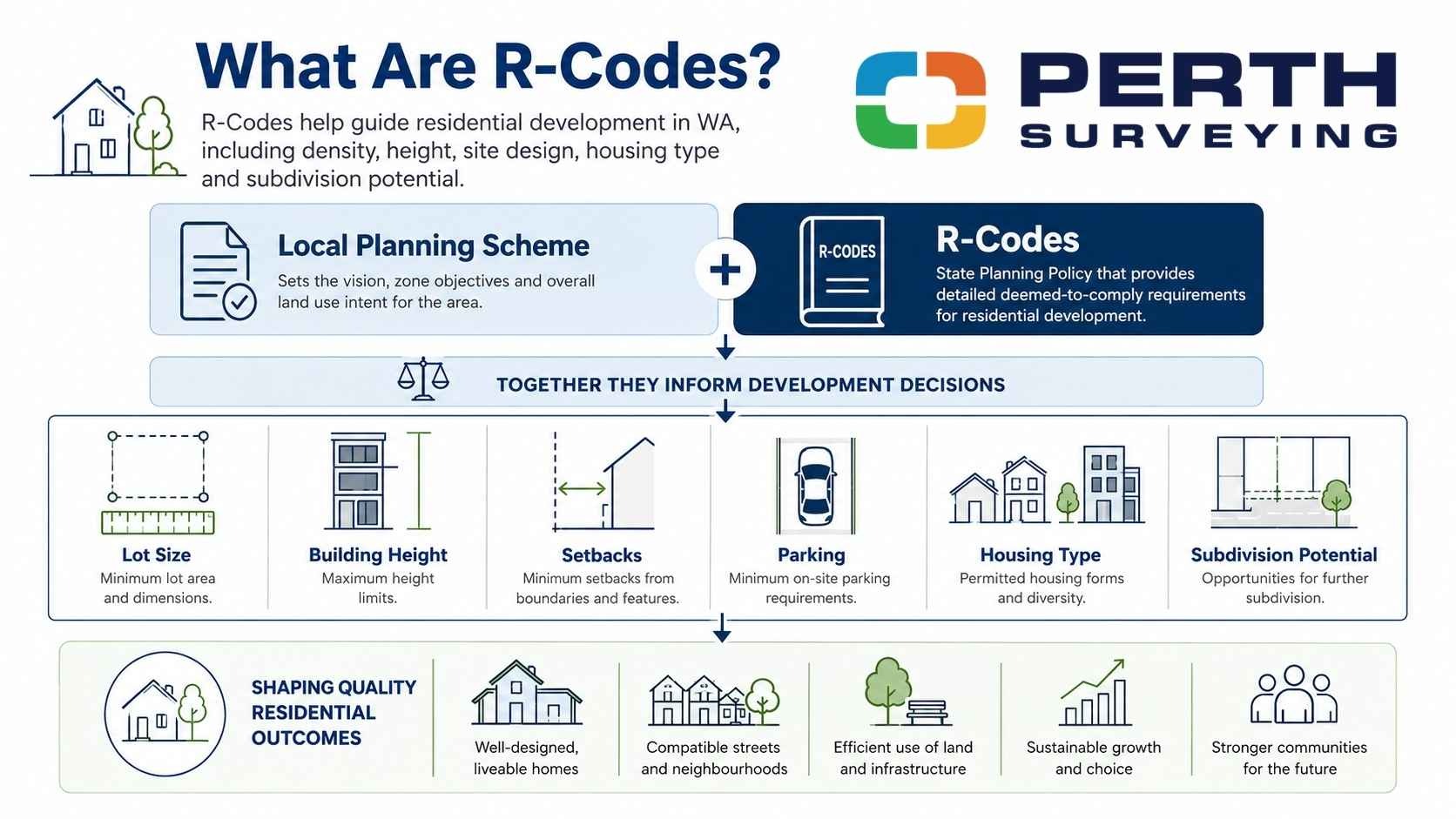
R-Codes are Western Australia’s residential planning and design rules, used alongside local planning schemes and policies to guide how residential land can be developed. They help guide what kinds of homes can be developed in different residential areas, including how density, height, design, and housing types are assessed.
Most residents do not think about R-Codes every day. Yet, much like a boundary line on a site plan, these rules quietly shape the streets around us. They influence whether a suburb remains almost entirely single-house, whether small apartment buildings can be built near activity centres, and whether young adults, downsizers, and first-home buyers have options close to established schools and services.
That matters because Perth is growing. As the city expands, we face a clear choice. We can keep spreading outward, placing more pressure on roads, infrastructure, and commute times. Or we can create more homes in well-located areas where shops, public transport, parks, and community facilities already exist.
The balance is important. Good planning should support growth while still respecting the places people know and care about. The proposed reforms are part of that broader direction.
Perth R-Code Density Reforms and the Idea of Gentle Density
Gentle density means adding more homes without turning every suburb into a high-rise precinct.
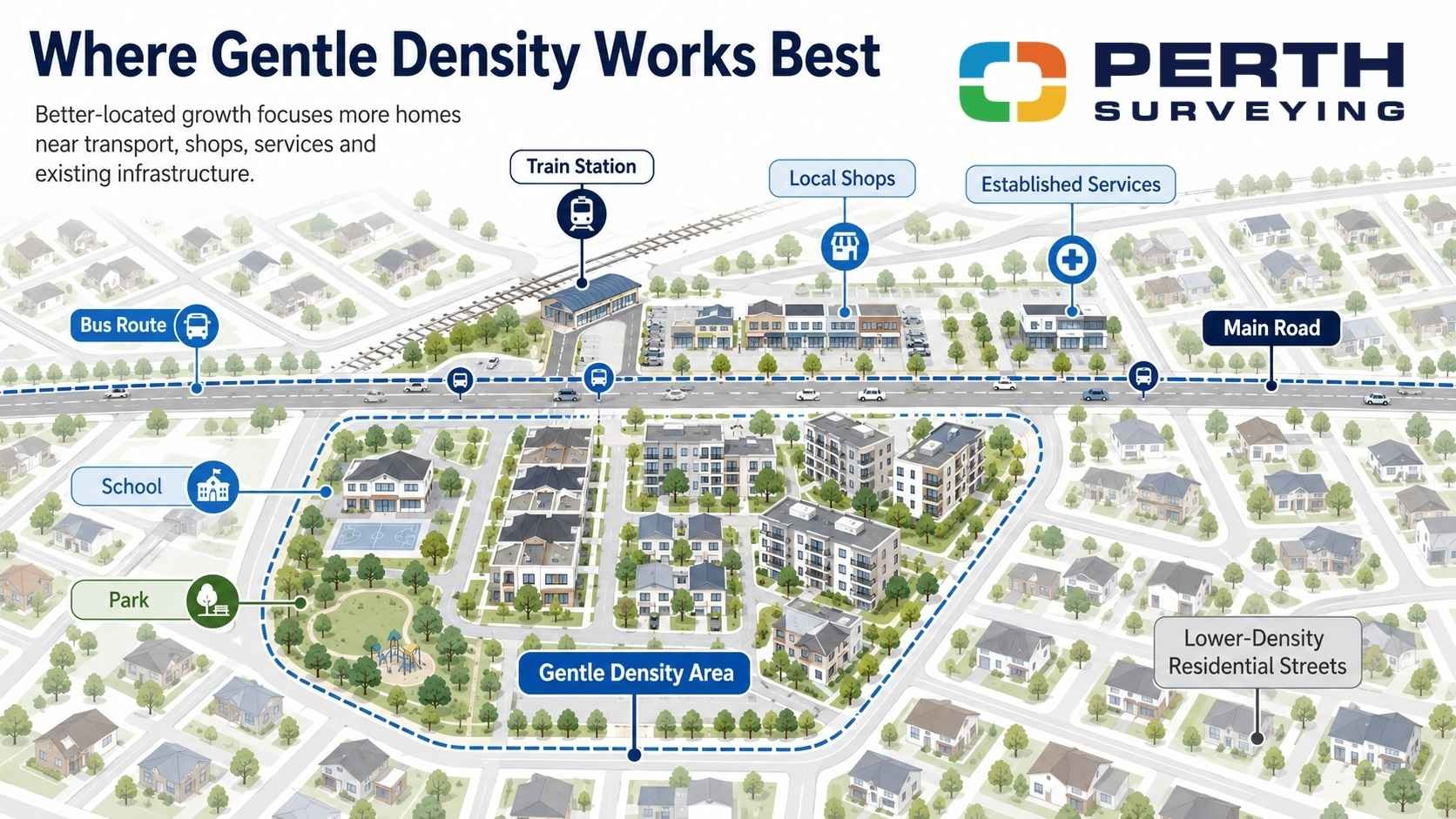
It is about creating a middle ground between the traditional detached house and large apartment towers. In practical neighbourhood terms, gentle density might mean more townhouses, smaller apartment buildings, well-designed grouped housing, and homes located closer to train stations, bus routes, and shopping hubs.
The goal is not density for its own sake. The stronger planning outcome is well-located housing that gives families more choice while making more efficient use of existing transport, schools, shops and community infrastructure.
For families and long-term residents, the aim is not to erase suburban character. The aim is to help suburbs evolve in a way that supports more housing choices while still keeping a strong sense of community.
Gentle density can help create neighbourhoods where:
- Adult children have a better chance of living near family.
- Older residents can downsize without leaving their suburb.
- Local shops have more nearby customers.
- Public transport becomes more useful because more people live within walking distance.
- Schools and community facilities can be supported by a more balanced local population.
For many families, this is the heart of the issue. The question is not only where new houses go. It is whether the next generation will be able to live near the communities that raised them.
Why a Shift from Two to Three Storeys in R40 Areas Matters
One of the key proposed changes is allowing three storeys in R40 areas, up from two storeys. This is especially relevant in parts of Perth where R40 land sits near public transport, shopping centres, main streets, and other local hubs.
R40 areas are already considered suitable for more compact residential development than lower-density suburban areas. The proposed height shift could allow small apartment buildings or other medium-density homes to work better on well-located sites.
For residents, the main point is clear. Importantly, a move from two to three storeys in suitable R40 areas would not mean high-rise development in every street. It would represent a more targeted increase in capacity where planning settings already support compact housing. It is a targeted form of added capacity in areas that are already better placed to absorb change.
This matters near transit and shopping hubs because those locations already have some of the ingredients needed for more homes:
- Better access to buses or trains.
- Nearby supermarkets, cafes, and everyday services.
- Walkable local streets.
- Existing community infrastructure.
- Reduced reliance on long car trips for every errand.
When more homes are built near these places, residents can often live closer to work, study, sport, childcare, and family support. That can make daily life more convenient and reduce the pressure to keep pushing housing further away from the city.
What Removing Parking Minimums Could Mean for First-Home Buyers
Another proposed reform is the removal of minimum parking requirements for apartments. This may sound highly technical, but it has a real impact on housing cost and choice.
From a practical construction perspective, parking bays are expensive to build, especially in apartment projects. When planning rules require a fixed number of bays, the cost often flows through to the final price of the home. For a first-home buyer looking near a train line, bus route, university, workplace, or town centre, that can make a meaningful difference.
Removing minimums does not mean every apartment will have no parking. Developers may still provide parking where buyers expect it, where site conditions allow, and where local planning settings or market demand support it. The difference is that the rules allow more flexibility.
This could support:
- More affordable apartment options.
- More choice for singles, couples, and young families.
- Better housing near transport.
- Less pressure to design every home around car ownership.
- More efficient use of well-located land.
For families thinking about their children’s future, this is an important part of the reform story. A first home does not always need to be a large house on the edge of the metro area. For many young people, a well-located apartment near work, study, public transport, and family is a realistic, accessible first step.
The Health Check Shows Progress, but There Is More to Do
Recent WA planning data shows the net infill rate was approximately 39% in 2024, up from 34% in 2023, while Perth and Peel, at 3.5 million, continue to work toward a long-term 47% infill target.
That is a positive shift. It shows Perth is moving in the right direction, with more housing being delivered within existing urban areas. At the same time, the city is still working toward the established 47% target, so there is more to do.
For residents, the health check is a useful reminder that growth is already happening. The real question is how well it is managed.
Good infill should be planned around access, services, and liveability. It should support homes near transport and activity centres. It should also give communities clear opportunities to understand, question, and respond to proposed changes.
What This Could Mean for School Catchments and Local Families
School catchments are one of the biggest practical concerns for Perth families. Many households choose where they live based on access to a preferred local school, and any shift in housing supply can raise questions about enrolments, traffic, and long-term capacity.
The R-Code reforms do not change school catchments by themselves. However, they may influence how many families, young adults, downsizers, and renters can live within established suburbs over time.
Over time, that could influence local enrolment patterns, traffic around schools, and the need for coordinated infrastructure planning.
In some suburbs, gentle density may help keep school communities stable by allowing younger families to move into areas where housing has otherwise become too expensive or limited. In other areas, more homes may increase the need for careful school and infrastructure planning.
This is why consultation matters. Residents know the daily rhythms of their own neighbourhoods. They know where school drop-off already feels busy, which intersections are difficult, where footpaths are missing, and which local centres are underused.
Planning reform works best when local knowledge is brought into the process early.
Future Housing Options for Children and Grandchildren
Many Perth parents worry that their children will not be able to afford to live near them as adults. This concern is not abstract. It affects family support, childcare, ageing parents, community sport, volunteering, and the simple comfort of staying close to people you love.
Gentle density can help by creating more housing steps within a suburb.
A young adult may start in a small apartment near a train station. A couple may move into a townhouse close to family. A downsizer may leave a larger home but stay near the same shops, doctor, friends, and community groups.
When a suburb offers only one main housing type, people often have to leave when their needs change. More housing variety can help people stay connected through different stages of life.
That is why the R-Code discussion should not be framed only as a development issue. It is a family issue. It is about whether Perth suburbs can support children as they grow up, move out, start work, form households, and perhaps raise families of their own.
Reassurance for Residents Who Are Worried About Change
It is completely reasonable for residents to have concerns. People care deeply about their streets, local parks, schools, and the character of their neighbourhoods.
The important thing to remember is that these reforms are proposed changes, not overnight changes. Draft changes are expected to go through public consultation later in 2026, with implementation expected from mid-2027. That gives everyone time to read the details, ask practical questions, and provide feedback.
A useful way to look at this is to focus on quality, not just quantity. Perth does need more housing options, but residents are right to expect careful planning around design, access, trees, walkability, infrastructure, and community feel.
A reassuring approach to density should not dismiss local concerns. It should bring them into the process early, clearly, and respectfully.
How Residents Can Have Their Say
Public consultation will be an important step in the R-Code overhaul. When consultation opens later in 2026, residents should take the opportunity to review the draft changes and make a submission.
A strong community response does not need to be overly technical. It just needs to be practical, local, and grounded in everyday experience. People who live in a suburb understand the everyday details that matter.
Residents may wish to think about questions such as:
- Where could gentle density work well in our suburb?
- Which streets have good access to public transport and shops?
- Where are footpaths, crossings, or traffic conditions already under pressure?
- How could more housing support local schools, clubs, and businesses?
- What design outcomes would help new homes fit better into the neighbourhood?
- What local character should be protected as the area changes?
Having your say is not only about objecting or supporting. It is about helping shape better outcomes. And, where relevant, understanding how the proposed settings may affect your own property.
A Community-Minded Way to Look at Perth’s Next Chapter
Perth’s neighbourhoods have never been frozen in time. They have always changed as families grow, transport improves, shopping areas evolve, and housing needs shift.
The proposed R-Code reforms are part of that ongoing story.
The challenge is to make sure change is thoughtful. More homes should be located where people can access services. Density should be gentle where suburbs need gradual change. School communities should be considered. First-home buyers should have realistic options. Older residents should have choices that allow them to stay local.
Most importantly, residents should feel informed rather than surprised.
At Perth Surveying, we believe clear, precise information helps people make better decisions about land, housing, and local change. These reforms are still moving through the process, but now is the right time for families and residents to understand the direction, follow the consultation process, and prepare to have their say.
Conclusion
The Perth R-Code density reforms are about more than planning rules. They are about how Perth can grow while keeping communities connected.
Gentle density, three storeys in suitable R40 areas, more flexible apartment parking, and a stronger focus on infill all point toward one bigger goal. Perth needs more housing choices in established, well-serviced neighbourhoods.
The health check shows progress, with infill rising from 34% to 39%, but there is still work to do to reach the 47% target.
For families, the reforms raise important questions about school catchments, local identity, and whether children will have future housing options close to the places they know.
Public consultation is expected later in 2026 ahead of implementation from mid-2027. Read the details when they are released, talk with your neighbours, and have your say.
For clear guidance on land, development context, and surveying requirements across Perth and WA, contact Perth Surveying.
Phone: 08 9303 2407
Email: sales@perthsurveying.com.au
Website: perthsurveying.com.au
FAQs
Do R-Codes apply across all Perth suburbs?
R-Codes apply across Western Australia, but the practical effect can vary by local planning scheme, residential coding, and local policy settings. Residents should always check information from their local government when they want suburb-specific guidance.
Will every R40 area automatically look the same?
No. R40 is a density code, but local context still matters. Street layout, lot patterns, local planning rules, design requirements, and community feedback can all influence how change appears in different areas.
Why is public consultation important if the reforms are already proposed?
Consultation gives residents, councils, industry, and community groups a genuine chance to respond before final decisions are locked in. It helps identify local issues, practical concerns, and design priorities that may not be obvious from a citywide policy view.
Do I need a survey before exploring subdivision potential?
A feature and contour survey or boundary survey can help clarify site conditions, levels, boundaries and constraints before you speak with designers, planners or your local government.
