Proposed R-Code Changes for 700sqm Perth Blocks
Proposed R-Code Changes: Could Your 700sqm Perth Block Become Subdividable?
Many Perth homeowners are now asking the same question:
“Could my 700sqm block be subdivided?”
The short answer is that some 700sqm R20 blocks may become more viable for subdivision if the proposed changes are introduced, but homeowners still need to check the final rules and the physical constraints of their site.
The WA Government has announced proposed R-Code reforms that could make subdivision more achievable for some R20 and lower-coded residential blocks, including some sites around 700sqm.
That does not mean every 700sqm block will qualify. As at July 2026, the reforms are still proposed, with public consultation expected before implementation.
But it does mean many homeowners should start paying attention.
For some, these proposed R-Code changes may create a chance to unlock land value, create a rear lot, build a second home, or prepare a property for future sale or development.
The first step is getting clear site information, so you know what your block allows, what may limit it, and what questions to ask before spending money on plans or development advice.
Before spending money on plans, builders, or development advice, you need to know what your property allows, what may limit it, and what information is needed to make a clear decision.
This article explains what the proposed R-Code changes could mean for Perth homeowners and mum-and-dad developers, especially those with around 700sqm of land.
What Are the Proposed R-Code Changes?
R-Codes are used for residential development and subdivision assessment in WA
The proposed R-Code changes are part of a wider WA Government plan to make residential development simpler and faster.
The main change getting attention is the proposal to remove the average lot size requirement for land coded R20 and below.
In practical terms, this could mean some Perth homeowners with blocks around 700sqm may have a better chance of subdividing than they do under the current rules.
At the moment, many R20 properties need to meet requirements that can make subdivision difficult, even when the block looks large enough. The proposed changes are designed to reduce that barrier and open up more infill housing opportunities in established suburbs.
The WA Government has said the proposed reforms could enable more than 50,000 existing residential properties across the Perth metropolitan area to be subdivided.
Other changes are also being considered. These include reducing approval timeframes for some single homes, removing minimum parking requirements for some apartments and granny flats, and allowing more height in certain medium-density areas.
But there is one important point homeowners need to understand.
These changes are proposed. They are not law yet. Homeowners should treat the announcement as an opportunity to prepare, not as subdivision approval.
The draft changes are expected to be released for public consultation later in 2026, with implementation currently expected from mid-2027. So while the announcement is important, homeowners should not assume they can subdivide immediately.
The smart move is to prepare early. Find out your zoning. Understand your block. Check the site constraints. Then you can make decisions based on facts, not headlines.
What Happens Next With the Proposed R-Code Changes?
The proposed R-Code changes are not in force yet. The final wording will matter, so every property will still need to be assessed against the confirmed rules.
The WA Government has announced the direction of the reforms, but the draft changes still need to go through public consultation before they are finalised.
That means homeowners should be careful about making decisions too early.
A 700sqm block that looks promising may become a stronger subdivision opportunity in the future, but it still needs to be assessed under the final rules once they are confirmed.
For now, the best step is preparation.
That means checking your zoning, confirming your lot size and boundaries, reviewing access and services, and getting the right survey information before committing to designs, builders or development plans.
The homeowners who prepare early will be in a better position when the rules become clearer.
They will know whether their property has genuine potential, what may limit it, and what questions to ask next.
Why Perth Homeowners Are Paying Attention
For many Perth homeowners, the family block is their largest asset.
The proposed R-Code changes have caught attention because they may give more owners a practical way to unlock value from land they already own. A block that once looked difficult to subdivide may become worth a closer look. For established Perth suburbs with older homes on larger blocks, this could make early site checks more valuable.
This is especially important for mum-and-dad developers. Most are not full-time property developers. They are homeowners who have built up equity over many years and want to make a careful decision.
They need clear information, honest guidance and confidence about what is possible before they spend money.
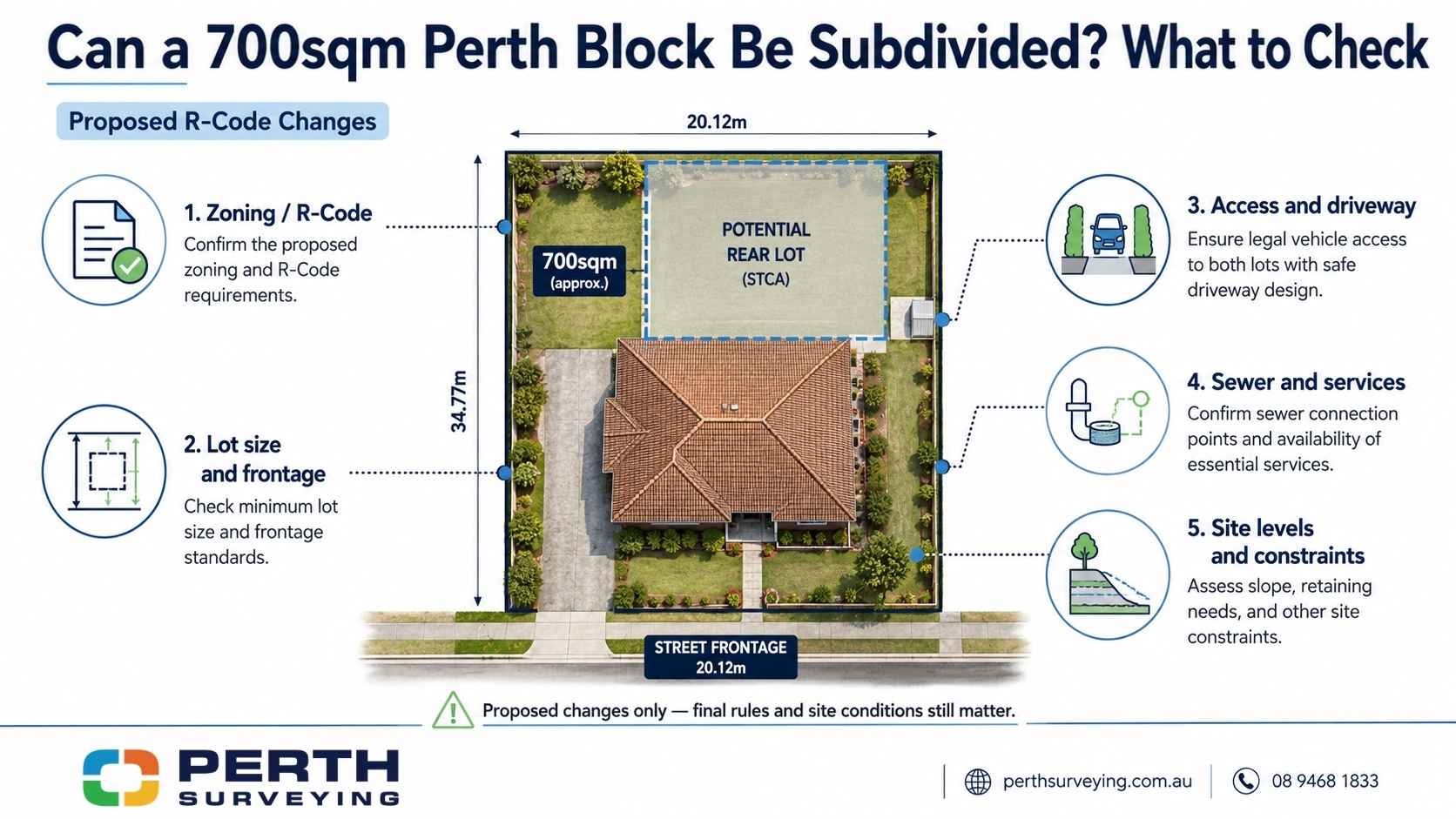
Could a 700sqm Perth Block Become Subdividable?
Under the proposed R-Code changes, some 700sqm Perth blocks may have stronger subdivision potential than they do under the current rules, provided the site also meets other planning and physical requirements.
For some homeowners, that could mean creating a rear lot and selling it. For others, it could mean building a second home, downsizing on the same property, or preparing the land for a future builder or developer.
This is why the 700sqm figure matters. Many established Perth suburbs have older homes sitting on larger residential blocks. Some of these properties may become more attractive for infill development if the proposed changes are introduced.
But size is only one part of the story. Access, services, levels, boundaries, easements and the existing house position can all change the outcome.
A 700sqm block may sound promising, but subdivision depends on the property itself.
Does Every 700sqm Block Qualify?
The proposed R-Code changes may create more opportunities, but they will not make every 700sqm block automatically subdividable.
A property still needs to be assessed properly. IImportant factors usually fall into three areas: planning controls, site access and services, and physical site constraints.
- Planning controls: zoning, residential density code, local government requirements, easements and restrictive covenants.
- Access and services: frontage, driveway access, sewer position, service connections and drainage.
- Physical site conditions: lot shape, levels, retaining, trees, existing structures and the position of the current home.
Two blocks can be the same size and have very different subdivision outcomes.
One may have clear access, suitable services and a house positioned well for a rear lot. Another may have access problems, difficult levels, sewer constraints or an existing home that makes subdivision harder.
That is why homeowners should not rely on block size alone.
The better question is not simply, “Is my block 700sqm?”
The better question is: “What does my block actually allow once the site details are checked?”
What Homeowners Should Do Before Spending Money
The proposed R-Code changes may create an opportunity. But opportunity is not the same as approval.
Before committing to plans, builders or development advice, confirm the physical facts of the site first.
A 700sqm property may look suitable on paper. A survey helps turn that early potential into clear, usable site information. But the real answer depends on what is on the ground, what is under the ground, and what the planning rules allow.
Start With the Basics
The first step is to check the key details of your property.
These may include:
- your zoning and residential density code
- your true lot size and boundary dimensions
- the shape and frontage of the block
- the position of the existing house
- driveway access
- sewer and service locations
- drainage requirements
- easements or restrictive covenants
- site levels and retaining requirements
- trees and other site constraints
Perth Surveying can help confirm key site information such as boundaries, levels, existing structures and site features, giving you a clearer base before the next planning or design step.
This information helps you avoid a common mistake: assuming a block can be subdivided just because it is large enough.
Lot size matters, but it is only one part of subdivision potential.
In real subdivision work, the problems are often not obvious from the street. A block may look simple until the levels, sewer position, retaining walls, access width or existing house location are properly checked. These details can affect whether a rear lot is practical, whether extra work is needed, and whether the numbers still make sense.
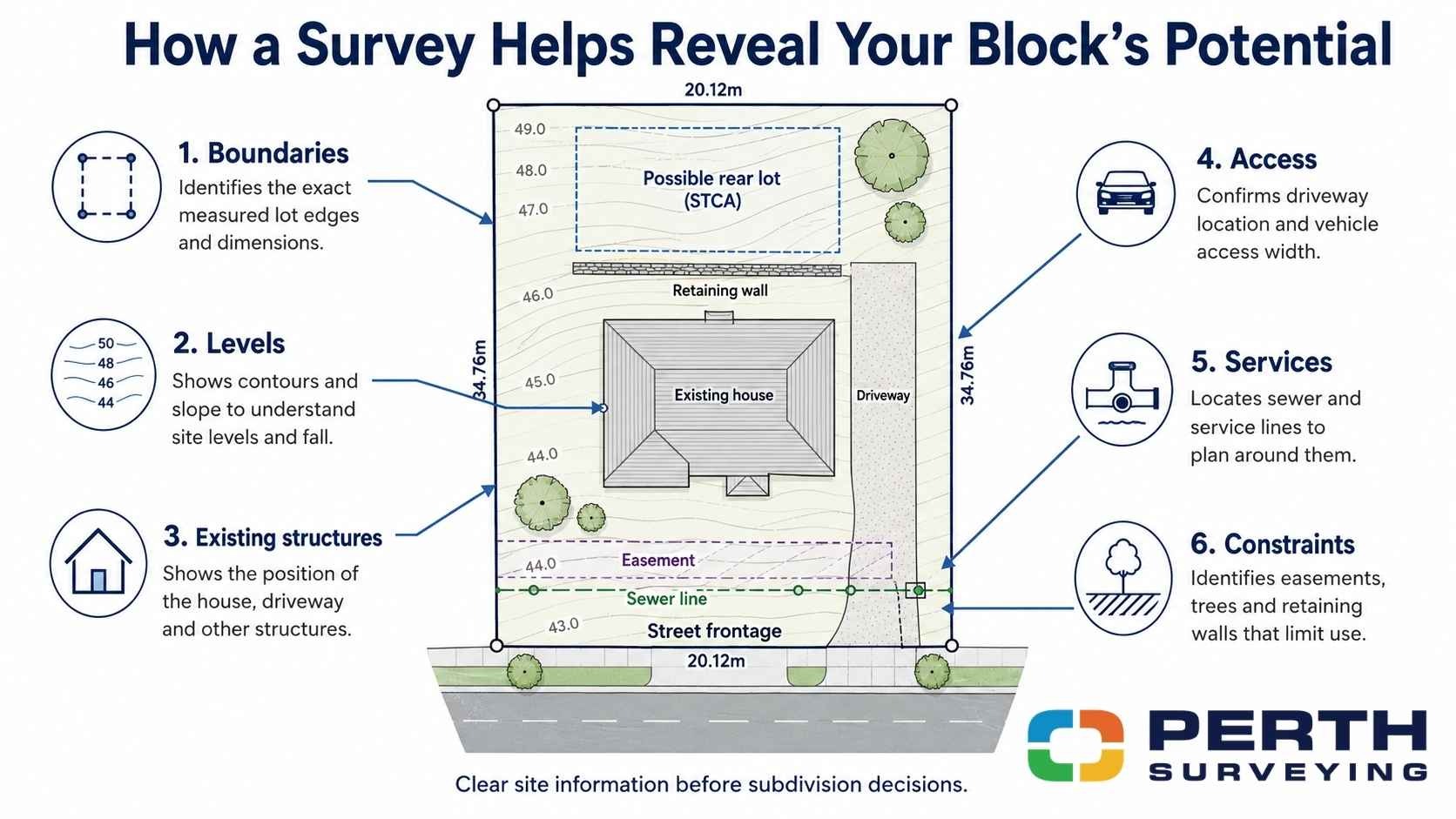
How a Survey Helps You Understand Your Block
A feature and contour survey, boundary survey or related site survey can give you the information needed to make better development decisions.
It can show boundaries, levels, existing structures, site features and constraints that may affect future subdivision or development.
For homeowners, this is often the point where the guesswork stops.
You can see where the house sits. You can understand how the land falls. You can identify access issues. You can see what may help or limit the subdivision potential of the block.
This information is useful before speaking with a builder, designer, planner or developer.
It gives everyone a clearer starting point. It also helps reduce avoidable delays by giving builders, designers, planners and developers clearer information from the beginning.
Why It Pays to Prepare Early
The R-Code reforms are not yet in force. But that does not mean homeowners should ignore them.
Preparing early can help you understand whether your block has genuine potential before you make larger financial decisions.
It may also help you decide whether to hold, sell, subdivide, develop or simply keep your options open.
For some homeowners, the right answer may be to wait.
For others, it may be worth getting the right survey information now so they are ready to move when the rules become clearer. That does not mean rushing into subdivision; it means having reliable site information ready when the final rules are confirmed.
The key is not to rush.
The key is to get clear information early, so your next decision is based on facts rather than headlines.
Find Out What Your Block Is Really Capable Of
The R-Code changes may create new opportunities for Perth homeowners, but every block still needs to be understood on its own merits.
Perth Surveying can help you take the first practical step.
A survey can give you clear information about your boundaries, levels, existing structures and site constraints. This gives you a better starting point before speaking with a builder, designer, planner or developer.
If you are wondering whether your 700sqm Perth block may have subdivision potential, start with the facts of the site: boundaries, levels, structures, access and constraints.
Call Perth Surveying on 08 9303 2407, email sales@perthsurveying.com.au or visit perthsurveying.com.au to discuss the right survey for your block.
You do not need to have all the answers before you call, the right first step is working out what information your site needs.
FAQs
Can I subdivide my 700sqm Perth block now?
Not automatically. The proposed R-Code changes are not yet in force, and your property still needs to be assessed against the final planning rules, site conditions and local government requirements.
Does every R20 block qualify for subdivision?
No. R20 zoning may be relevant, but subdivision potential depends on more than the density code. Lot size, frontage, access, sewer, drainage, easements, levels and the position of the existing house can all affect the outcome.
Should I get a survey before planning a subdivision?
Yes. A survey can confirm key site details such as boundaries, levels, existing structures and site features before you spend money on designs or development plans. This will help you to make better decisions before you spend money on designs or development plans.
What does R20 mean in Perth?
R20 is a residential density code used in WA planning. It helps guide how land may be developed or subdivided, but it does not guarantee that a property can be subdivided.
What could stop a 700sqm block from being subdivided?
Access, frontage, sewer location, drainage, easements, retaining walls, levels, trees, existing structures and local government requirements can all affect subdivision potential.
What survey do I need before checking subdivision potential?
Many homeowners start with a feature and contour survey, boundary survey or both, depending on what needs to be confirmed about the site. Perth Surveying can help identify the right first step.
When are the proposed R-Code changes expected to start?
The draft changes are expected to go through public consultation first, with implementation currently expected from mid-2027. Homeowners should confirm the final rules before making subdivision decisions.
