Subdivision of Land: Key Challenges for WA Owners
Subdivision of Land: Key Challenges for WA Owners
Subdividing land can look simple from the outside. You have a block. You see space. You imagine a second lot, a new home, or a stronger return from land you already own.
But in Perth and across WA, the subdivision of land is rarely decided by appearance alone.
Zoning, lot size, access, drainage, sewer location, easements, retaining, council requirements and WAPC conditions can all affect what is possible. Some issues are easy to manage when they are found early. Others become expensive when they are discovered after plans have already been drawn. A reliable surveyor can help identify those risks early so your planner, designer and builder are working from the same facts.
That is why the first step is not to guess what your land might achieve. It is to get clear survey information before money is spent on designs, applications or assumptions.
In this guide, we explain the common challenges landowners face during the subdivision of land in WA, and how proper surveying, planning and early advice can help keep your project moving with fewer surprises.
Council And WAPC Approvals Can Take Longer Than Expected
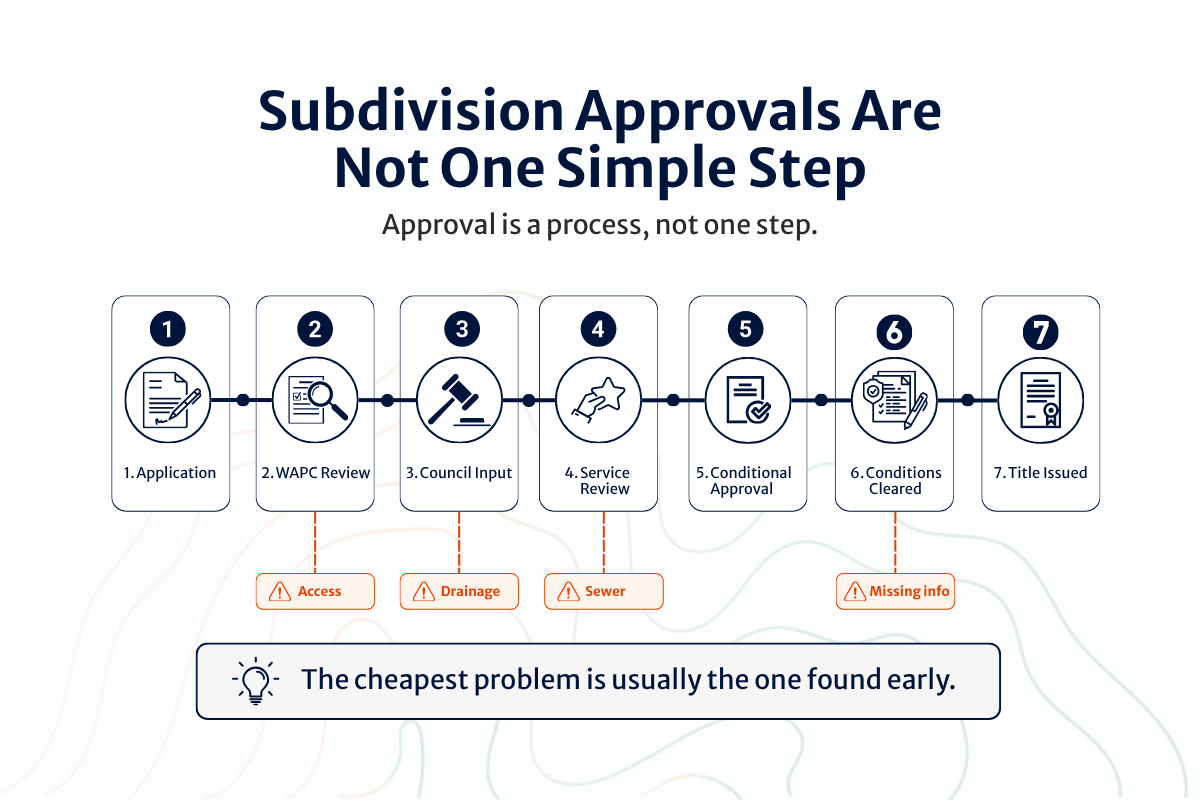
A subdivision is rarely approved through one simple step.
In WA, the subdivision of land usually involves the Western Australian Planning Commission, your local council, and service authorities. Each party may need to review part of the proposal. Each may ask for information. Each may place conditions on the approval. Those conditions need to be understood early, so the right survey, engineering and documentation work can be planned in the right order.
This is where many landowners are caught by surprise.
The first delay often comes from missing or unclear information. A plan may look acceptable on paper, but questions can arise around access, drainage, sewer connection, road widening, easements, retaining walls or compliance with local planning requirements. When that happens, the project can stop while the issue is clarified.
The second delay comes after conditional approval. Many owners think approval means the subdivision is finished. In most cases, it means the project can move forward once certain conditions are met. These conditions may require further surveying, engineering, service connections, clearances, documentation and final lodgement before titles can be issued.
That’s why timing counts.
Long approval periods can affect finance, building plans, sale contracts and holding costs. It can also frustrate owners who expected a quick outcome, only to discover that subdivision involves several coordinated approval, clearance and lodgement steps.
The best way to reduce avoidable delays is to start with accurate site information, clear guidance and a realistic understanding of the approval pathway. A proper survey helps planners, designers, engineers and approval authorities work from the same facts. It also helps identify problems before they become expensive interruptions.
In the subdivision of land, the cheapest problem is usually the one found early.
Site Constraints Can Change The Project
No two blocks behave the same.
Two properties may look similar from the street, but the subdivision outcome can be very different once the land is properly assessed. The subdivision of land depends on more than lot size. It depends on what is on the site, under the site, beside the site and required around the site.
A block may be large enough in theory, but still difficult or costly to subdivide in practice.
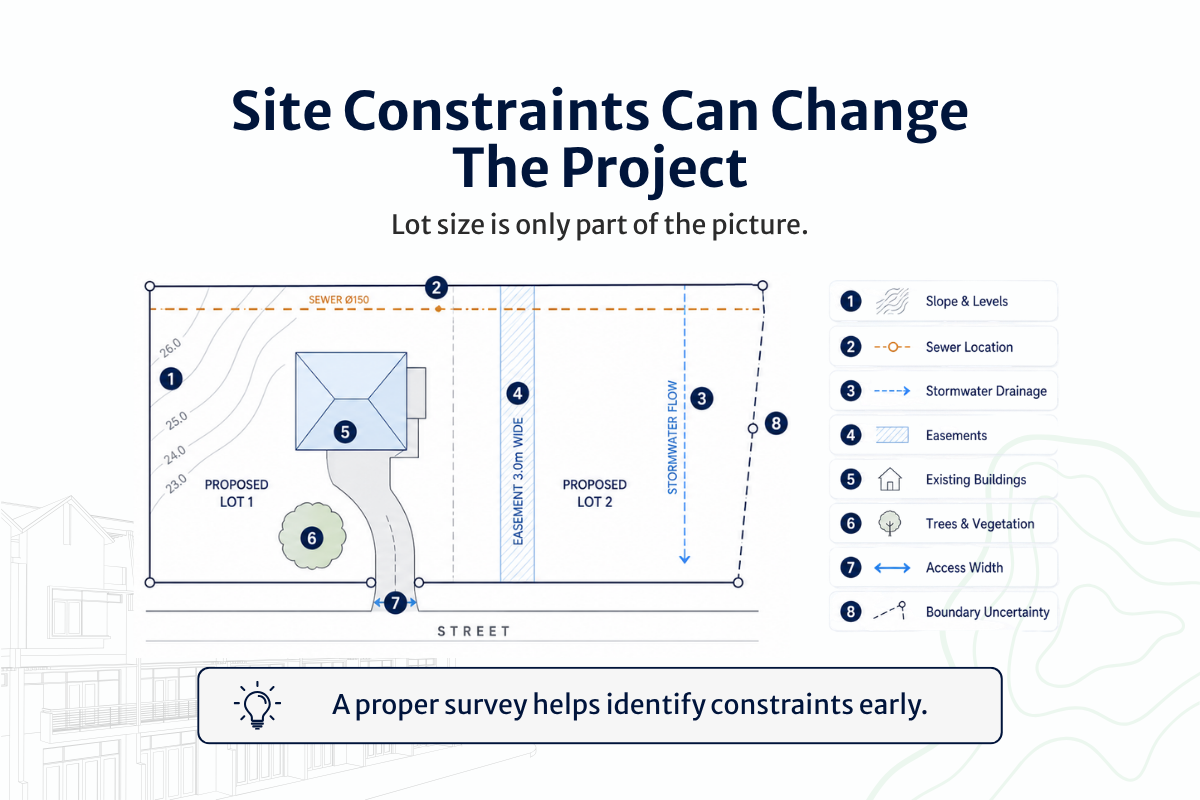
Common site constraints include:
- Slope and levels: Even a small slope can affect driveways, drainage, retaining walls and future building design.
- Sewer location: An awkward sewer position can affect where the new lot, driveway or future home can go.
- Stormwater drainage: Rainwater needs to be managed properly, and some sites require a more detailed drainage approach.
- Easements or service corridors: Pipes, services or access rights may limit what can be built on part of the land.
- Existing buildings: A house, shed or structure may sit where access, services or the new lot need to go.
- Trees and vegetation: Some trees may need to be retained or assessed before the land can be developed.
- Access width: A narrow driveway or tight side access can make a rear-lot subdivision more difficult.
- Boundary uncertainty: The fence line is not always the legal boundary. On a tight subdivision, even a small difference can matter.
This is why a proper survey is not just a formality. It gives you the facts before decisions are made. For many owners, this is the difference between designing around the actual site and redesigning after a problem appears.
Without accurate site information, plans may need to be changed later. A designer may draw a layout that does not work. A planner may discover a restriction after the application has started. A service authority may require changes that affect the whole project.
That means more time, more cost and more frustration.
The safer approach is to identify the constraints early. Once the land is properly measured and understood, your planner, designer, engineer and surveyor can work from the same information.
Service Connections Can Add Cost And Time
Services are one of the parts people often forget about at the start.
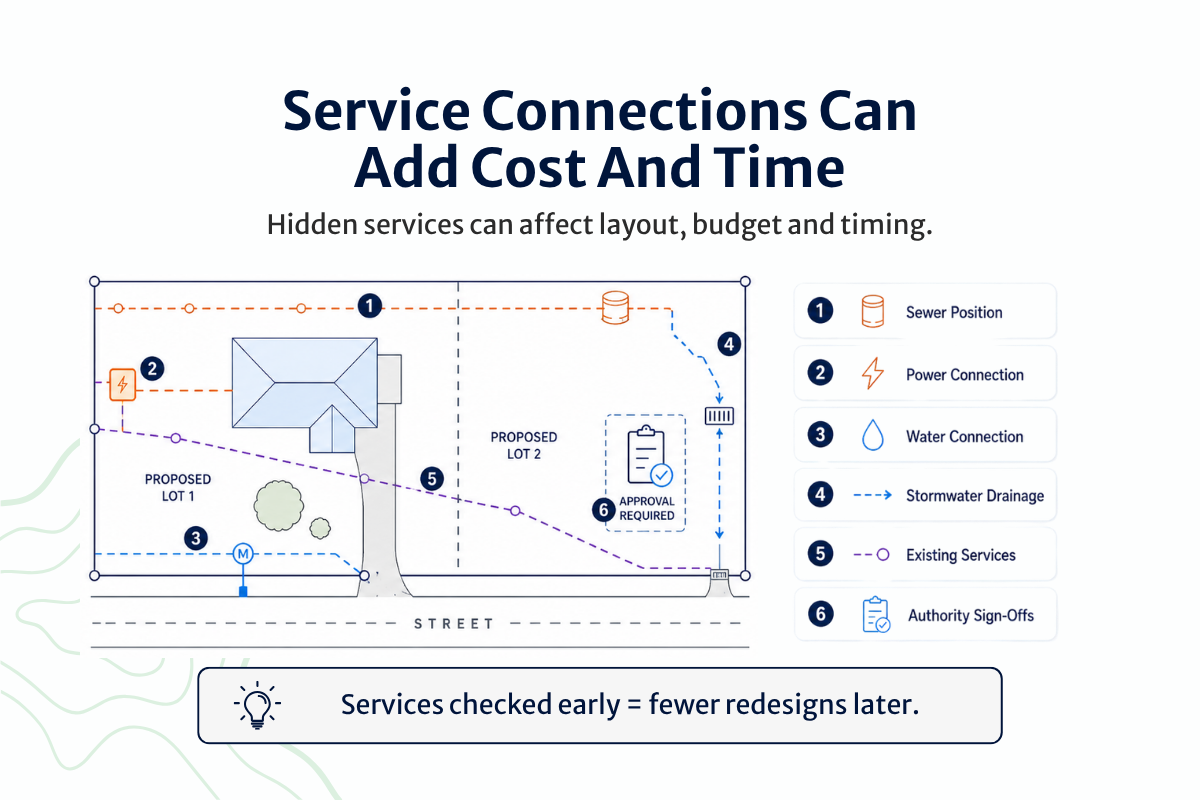
The earlier these service locations and requirements are checked, the easier it is to design a layout that is practical, compliant and cost-aware. That can include water, sewer, power, drainage and other connections.
This is where costs and delays can increase, especially if existing services do not suit the proposed lot layout.
Common service issues include:
- The sewer may need extra work: If the sewer connection is not in the right spot, it can affect the layout or add more work.
- Power may need to be upgraded or moved: A new lot may need its own supply, and that can take time to organise.
- Water connections may not be straightforward: The location of existing pipes can change what needs to happen next.
- Drainage can become a bigger issue than expected: The site may need a proper plan for stormwater before approvals can move forward.
- Old services may not match the new plan: Existing pipes, meters or connections may need to be changed once the land is split.
- Different authorities may need to sign off: This can add steps, paperwork and waiting time.
These things are not always obvious when you first look at the property.
That is why the subdivision of land should be checked properly before you commit to a design. If services are missed early, they can hold up the project later. They can also change the budget.
The best approach is to confirm where the services are, what needs to be connected, and whether any authority requirements are likely to affect timing, cost or design.
It is better to know this before plans are finalised, not after money has already been spent.
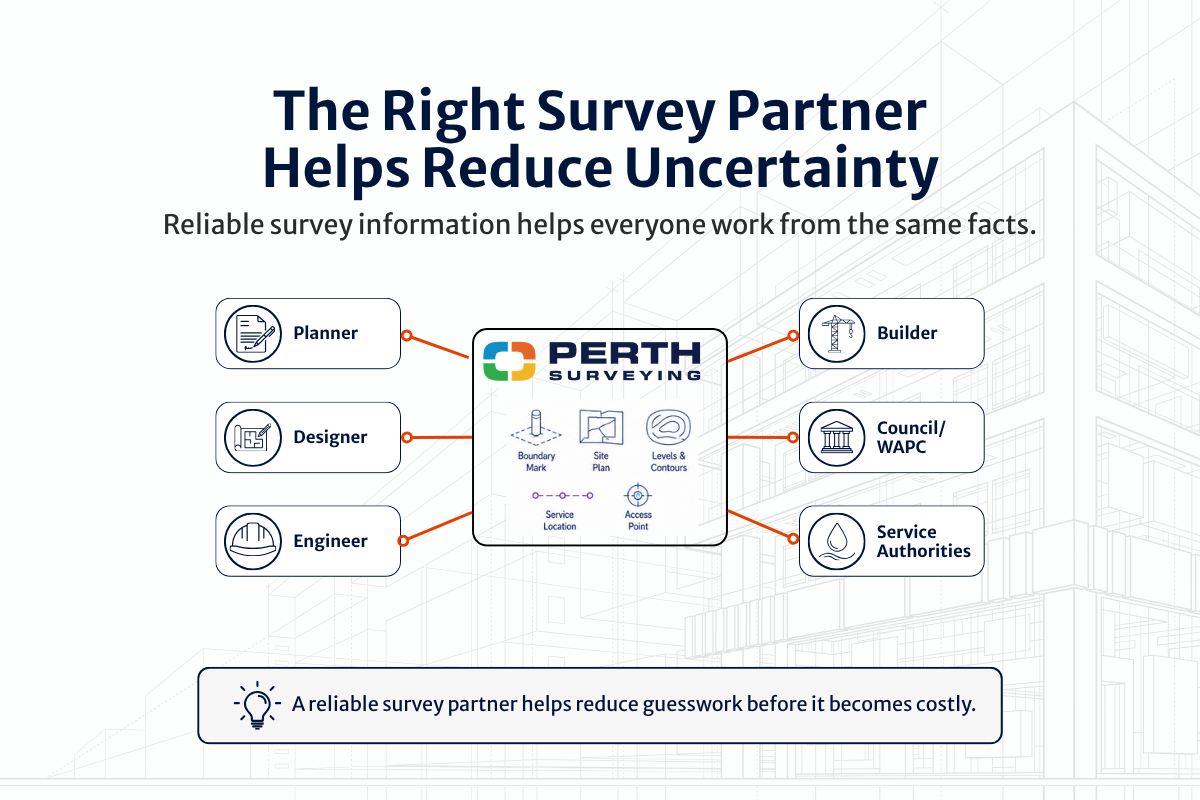
The Right Survey Partner Helps Reduce Uncertainty
A subdivision has a lot of moving parts.
You may be dealing with council, WAPC, service providers, planners, engineers, builders and neighbours. Each step can raise a new question. What can be built? Where are the boundaries? Where can access go? What needs to be shown on the plan?
This is where a reliable local survey partner like Perth Surveying can make a real difference.
A good surveyor does more than measure a block; they help create the reliable site information your project team needs to make better decisions.
Clear Information From The Start
Many subdivision problems start with guesswork.
A fence is assumed to be the boundary. A driveway is assumed to fit. A block is assumed to be easy to split because it looks big enough.
But assumptions can be expensive. A clear survey helps replace assumptions with measured information.
A proper survey gives you a better starting point. It shows what is actually on the land, not just what appears from the street. This gives your planner, designer or builder the right information from the beginning, so the next step can be planned with more confidence.
Fewer Surprises Later
A survey cannot remove every project risk, but it can bring important issues into view earlier.
That early visibility can make the project easier to plan, price and coordinate.
Things like levels, boundaries, existing buildings, access points and service locations can all affect the subdivision of land. When these details are known early, they are usually easier to deal with.
When they are found later, they can mean new plans, extra costs and more waiting.
Better Support For The People Involved
Subdivision usually involves more than one person.
Your planner may need site details. Your engineer may need levels. Your builder may need clear set-out information. Approval bodies may need plans and documents prepared in the right way. Clear survey deliverables help each party understand what is being proposed and what information still needs to be completed.
When the survey information is clear, everyone is working from the same base, with fewer assumptions and fewer back-and-forth questions.
This can reduce back-and-forth, avoid confusion and help the next step happen sooner.
Local Knowledge Matters
Subdivision rules and approval steps can vary depending on where the land is located.
A survey team that works across Perth Metro and broader WA will have practical experience with common site issues, local requirements and the types of delays that can affect subdivision projects.
That experience can help you ask better questions before you commit too much money.
It can also help you understand whether the project is likely to be
Guidance You Can Actually Understand
For many landowners, the hardest part is not just the process.
It is knowing what happens next.
A good survey partner should explain things clearly. You should know what is being done, why it matters, and what information is needed for the next step.
The subdivision of land is easier to manage when you are not left guessing. Clear advice helps you understand the process, prepare for likely requirements and avoid making decisions on incomplete information.
That is why choosing the right survey partner early can save more than time. It can give you confidence that the project is being handled with the right information from the start.
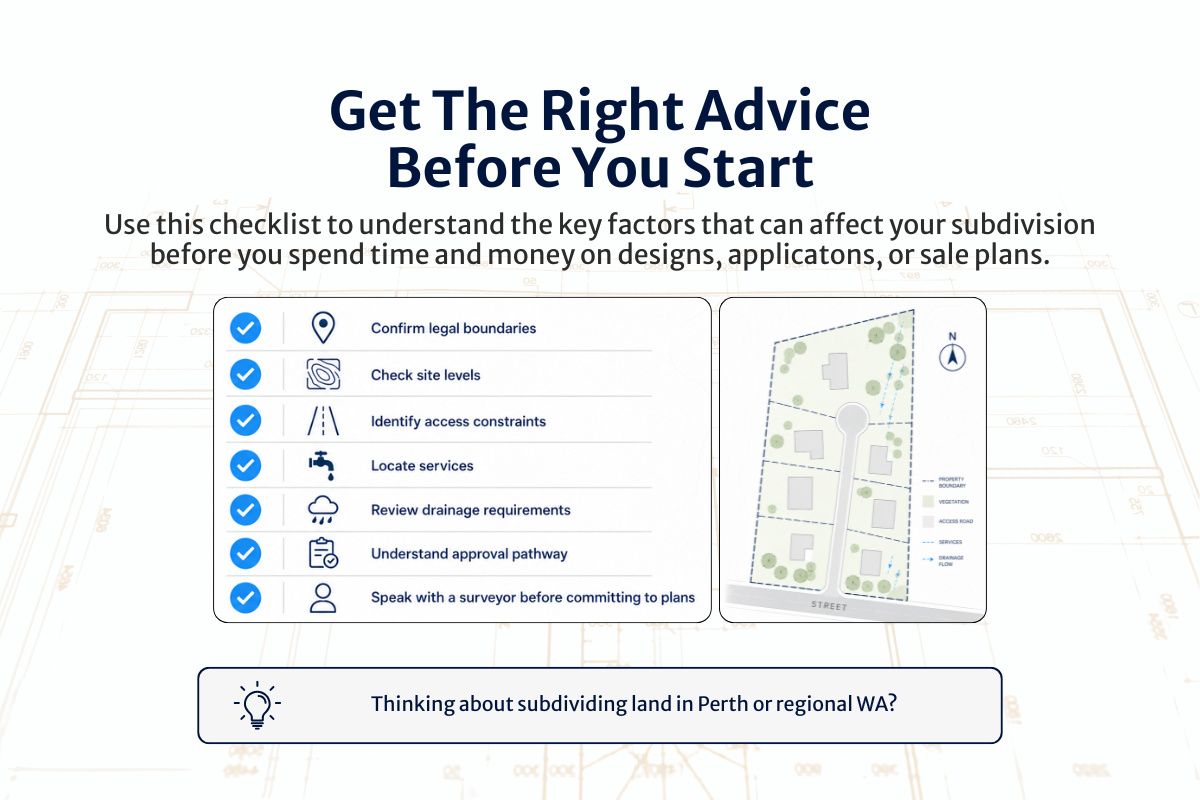
Get The Right Advice Before You Start
The subdivision of land can be a practical way to unlock value in your property, but only when the site, services and approval pathway are properly understood.
But it is not something to rush into.
A block may look simple at first. Then the details appear. Boundaries, access, services, drainage, approvals and site conditions can all change what is possible. They can also change the cost and the timeline.
The best time to find these things out is early.
Before you spend money on designs, applications or sale plans, get clear information about the land and the likely subdivision requirements. A proper survey can show what is really there and help the people involved make better decisions from the start.
Thinking about subdividing land in Perth or regional WA? Speak with Perth Surveying before you commit to plans or applications. Call 08 9303 2407, email admin@perthsurveying.com.au, or visit perthsurveying.com.au.
FAQs
What usually slows a subdivision down?
It is often the things people do not see at the start. Sewer lines, drainage, access, old buildings, unclear boundaries or extra approval conditions can all slow things down. With the subdivision of land, the delay is often not the big idea. It is the small site details.
Can I tell if my block can be subdivided just by looking at it?
Not really. A block might look large enough, but that does not mean it will work. The shape of the land, road access, services, slope and council requirements all matter. It is worth checking properly before spending money on plans or making decisions around the property.
Why should I get a survey early?
Because it's expensive to guess. A survey shows what is really on the ground. It can identify boundaries, levels, buildings and other site factors that may affect the subdivision. Your planner, builder or designer can then work from accurate information before the project gets too far down the road.
When should I contact a surveyor about a subdivision?
It is best to contact a surveyor before you commit to designs, applications or sale plans. Early survey advice can help identify boundaries, levels, services and site constraints before they become more expensive to resolve.
