Subdivision Process in Perth: Land Subdivision Guide

Subdivision Process in Perth: Turn Your Block Into New Titles With Confidence
Subdividing land in Perth can unlock serious value in your property, but the result depends on getting the right advice before money is spent on applications, designs, or site works.
The subdivision process in Perth involves more than drawing a new boundary line. You need to understand what your block can support, what approvals are required, what surveys are needed, how long each stage may take, and where costly delays can occur. For many homeowners and small developers, the hardest part is not deciding to subdivide. It is knowing the right first step.
That is where good surveying advice makes the difference.
At Perth Surveying, we help property owners, builders, and developers move through the subdivision process with clear guidance, accurate survey work, and practical next steps. Our role is to give you certainty early — so you know whether your land has development potential, what information council and planning authorities are likely to need, and how to keep the project moving without unnecessary back-and-forth.
In this guide, we explain the subdivision process in Perth in plain English: what happens first, who is involved, what surveys are required, and how to avoid the common mistakes that slow projects down.

What Is a Land Subdivision?
A land subdivision is the process of dividing one parcel of land into two or more separate lots, so each lot can be sold, developed, or held under its own title.
The idea sounds simple. The outcome can be valuable. But the steps in between matter.
A well-planned subdivision can unlock hidden value in your property, create an additional building site, support a family development, or prepare land for sale. A poorly planned subdivision can lead to delays, unexpected costs, redesigns and frustrating approval issues.
The subdivision process in Perth is not just about drawing new lines on a plan. Before anything moves forward, the land must be properly assessed. Zoning, lot size, street access, drainage, sewer connections, service locations, easements, retaining, site levels, and local planning rules can all affect what is possible.
That is why the first step should not be guessing. It should be getting clear advice.
Before you spend money on designs, applications, or consultants, you need to know whether your land is suitable, what the likely constraints are, and what information will be needed to progress the subdivision properly.
Perth Surveying helps Perth property owners, builders, and developers take that first step with confidence. We provide the survey work, plans, and practical guidance needed to understand your site and move through the subdivision process with fewer surprises.
You get clear answers, accurate documentation, and a better view of the path from first site review through to new titles.
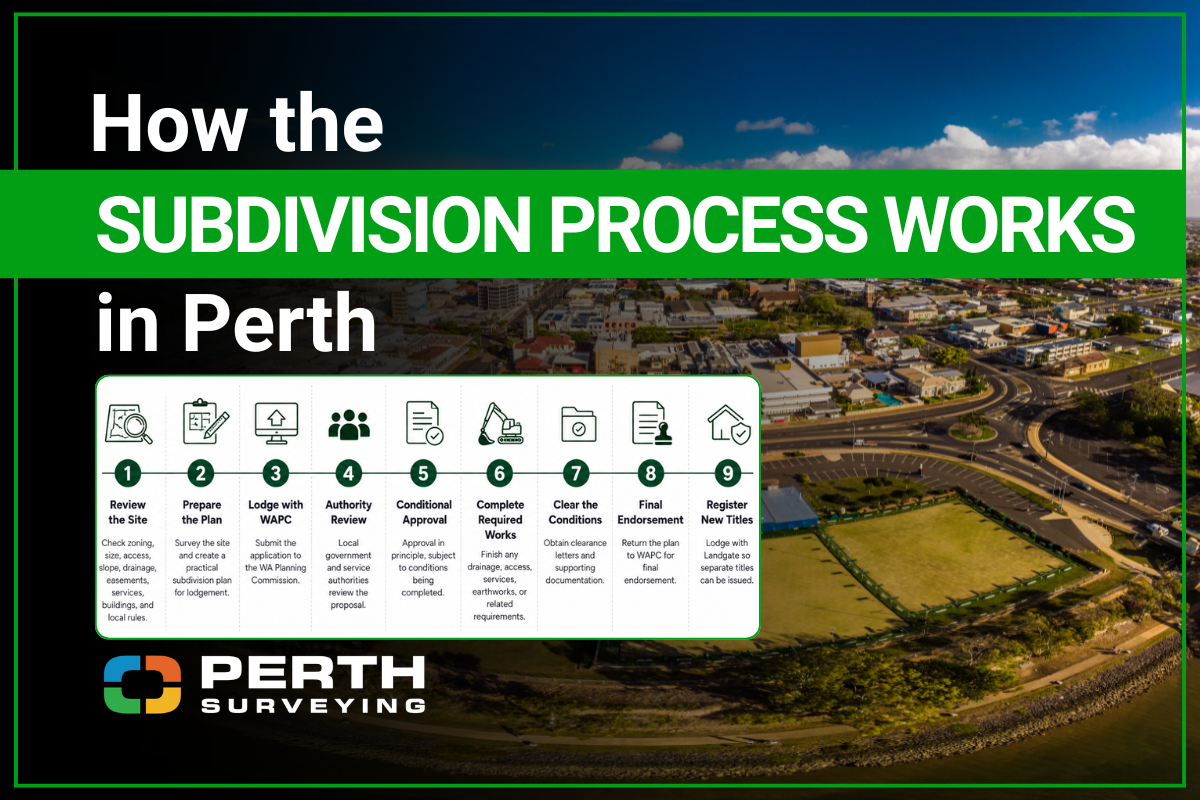
How the Subdivision Process Works in Perth
Most subdivisions are not delayed by one major issue. They are usually held up by smaller details that were missed at the beginning.
Access. Drainage. Sewer connections. Easements. Site levels. Service locations. Planning conditions. Authority approvals.
Any one of these can affect the lot layout, the work required, and the time it takes to reach new titles. The subdivision process for Perth property owners is designed to work through these details in the right order, so the project can move from early investigation to approval, clearance, and title creation with fewer surprises.
The more you understand the site at the start, the fewer surprises you are likely to face later.
Step 1: Start With the Block, Not the Paperwork
Before an application is prepared, the land itself needs to be properly reviewed.
This is where many subdivision projects either gain momentum or run into problems. A block may look suitable from the street, but subdivision potential depends on more than land size. The site needs to be checked against planning rules, physical conditions, servicing requirements, and practical access.
A proper site review considers factors such as:
- Zoning
- Lot size
- Street frontage
- Vehicle access
- Site slope and levels
- Drainage
- Easements
- Sewer and service connections
- Existing buildings
- Local planning requirements
These details matter because they shape what can be approved, what conditions may apply, and what extra work may be required before titles can be issued. Finding these issues early can help avoid redesigns, extra consultant costs, and delays once the application is already moving.
Step 2: Prepare a Practical Subdivision Plan
A subdivision plan is more than a drawing. It is the first serious test of whether the idea works.
It shows how the land is proposed to be divided, how the lots will function, and what the assessing authorities need to understand. A good plan makes the proposal easier to assess. A poor one can create questions before the application has properly begun.
Perth Surveying completes the site survey, prepares the subdivision plan and organises the supporting information needed for lodgement. The aim is simple: give the application accurate information from day one, so the process starts cleanly and avoids unnecessary back-and-forth.
Step 3: Lodge the Application with the WAPC
The application next proceeds to the Western Australian Planning Commission (WAPC). They are the authority responsible for assessing subdivision applications in WA.
Accuracy is important at this level. The WAPC examines the subdivision plan and other papers against the appropriate planning requirements. Before lodging, review how to prepare a WAPC subdivision application so you understand the supporting documents and site information that may be needed. Clarity of information will decrease confusion and offer the plan the best opportunity of being appraised on the facts.
Step 4: Referral Comments and Authority Review
Once the application is lodged, the WAPC may refer it to local government and servicing authorities for comment.
Each authority reviews the part of the proposal that affects its area of responsibility. The local government may review planning matters, access and local requirements. Servicing authorities may look at sewerage, water, electricity, drainage and other infrastructure issues.
This stage is not just paperwork. It is often where practical site issues first become formal requirements.
Step 5: Understand the Conditional Approval
If the application is supported, the WAPC may issue conditional approval. This is a positive step, but it is not the finish line.
Conditional approval means the subdivision is approved in principle, provided certain requirements are completed first. These conditions may relate to:
- Drainage
- Access
- Service connections
- Easements
- Road requirements
In plain terms, the project can move forward, but there are still requirements to complete before new titles can be created. This is a key stage in the subdivision process that Perth property owners need to understand clearly.
Step 6: Complete Any Required Works
There are no two subdivisions alike. Some require physical labour on-site, others need mostly documentation, service agreements, updated plans, or authority sign-offs.
Common requirements may include drainage works, crossovers, access construction, sewage or water connections, earthworks, utility improvements or infrastructure changes. The specific requirements will be determined by the property, the planned lot configuration and the terms of the approval.
This is where early planning helps. Once the conditions are understood well, it is easier to arrange, price and finish the next tasks.
Step 7: Get the Conditions Cleared
Once the required items are complete, the relevant authorities must confirm that their conditions have been satisfied. This is usually done through clearance letters.
This stage often takes longer than expected. One authority may be waiting on a document. Another may need proof that work has been completed. One missing item can hold up the entire subdivision.
Perth Surveying helps clients understand the survey-related requirements, prepare the right documentation, and keep the clearance process moving towards new titles.
Step 8: Submit for Final Endorsement
By this stage, most of the hard work has usually been done.
The conditions have been worked through, the required sign-offs have been obtained, and the plan now goes back to the WAPC for final endorsement.
This is not about starting the approval process again. It is more like a final check before the subdivision can move into the title stage. The WAPC needs to be satisfied that the conditions attached to the approval have been dealt with properly.
For many owners, this is the point where the project starts to feel close. The delays, documents, follow-ups and site requirements are nearly behind you. Once the plan is endorsed, the subdivision process in Perth moves into its final legal step.
Step 9: Register the Plan and Create New Titles
Once final endorsement has been received, the plan is lodged with Landgate.
Landgate registers the plan and new titles can then be issued for the subdivided lots.
That is when the subdivision becomes legally real. What was once one block of land is now recognised as separate lots, each with its own title.
That matters because it gives the owner options. One lot may be sold. Another may be kept. A builder may move ahead with construction. A family may use the new lot as part of a longer-term plan.
This final stage is why the early work matters so much. A subdivision is not just about getting an approval. It is about reaching the point where the land is properly divided, registered, and ready for its next use.
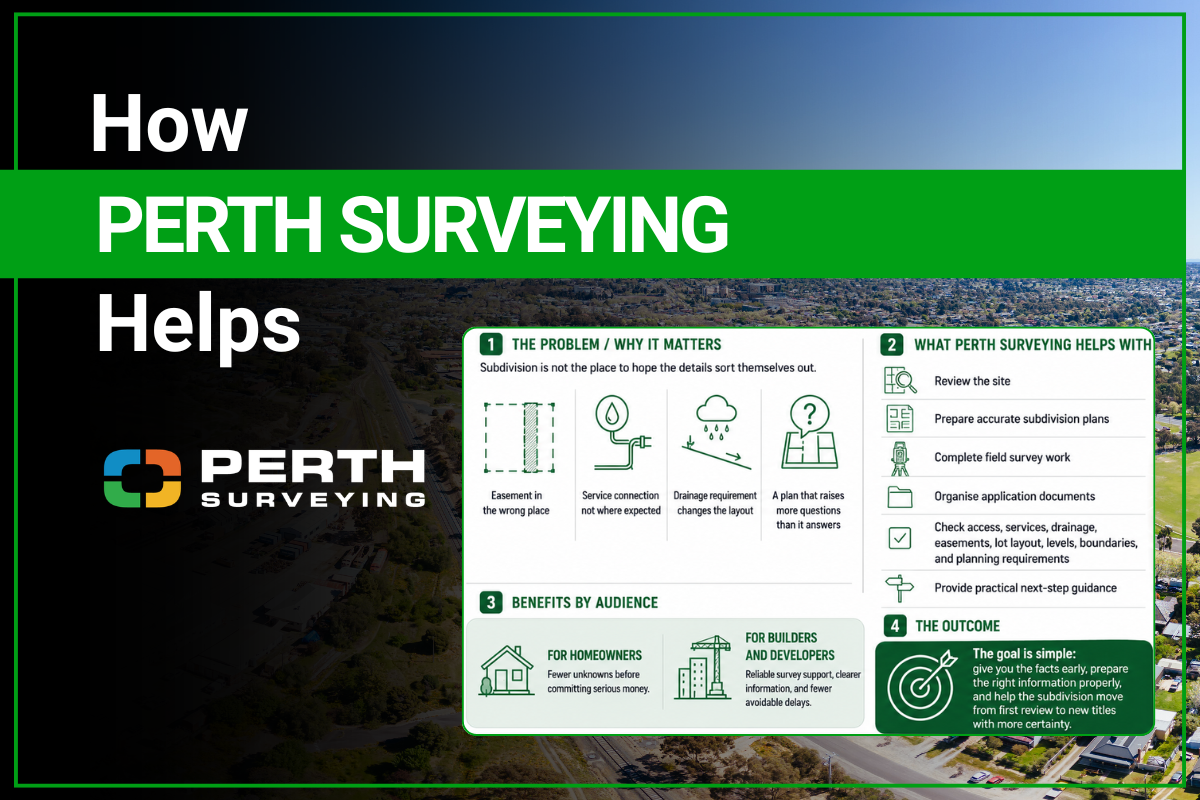
How Perth Surveying Helps
Subdivision is not the place to hope the details sort themselves out.
A small issue missed early can become a slow and expensive problem later. An easement in the wrong place. A service connection that is not where it was expected. A drainage requirement that changes the layout. A plan that raises more questions than it answers.
That is why the right survey advice matters before the application goes in.
Perth Surveying helps you understand what your land can realistically support, what may limit the subdivision, and what needs to happen next. We review the site, prepare accurate subdivision plans, complete the field survey work, and help organise the documents needed to support the application.
You get clear guidance on the details that usually decide whether a subdivision moves smoothly or stalls: access, services, drainage, easements, lot layout, levels, boundaries, and local planning requirements.
For homeowners, that means fewer unknowns before committing serious money. For builders and developers, it means reliable survey support, clearer information, and fewer avoidable delays.
The goal is simple: give you the facts early, prepare the right information properly, and help the subdivision move from first review to new titles with more certainty.
Call 08 9303 2407, email admin@perthsurveying.com.au, or visit perthsurveying.com.au.
FAQs About the Subdivision Process in Perth
Where do I start if I want to subdivide my land?
Start by finding out whether the block is actually suitable for subdivision. A lot can look promising on paper, but things like zoning, lot size, access, drainage, easements, slope and service connections can all affect what is possible.
Perth Surveying can review the site and talk you through the likely pathway before you spend time and money on a full application.
Who decides whether a subdivision is approved?
In Western Australia, subdivision applications are assessed by the Western Australian Planning Commission (WAPC).
The WAPC may also ask the local government and relevant service authorities to comment on the application. This can include matters such as planning rules, access, drainage, sewerage, water, electricity and other site requirements.
Do I need a surveyor to subdivide land in Perth?
Yes, a surveyor is an important part of the process. Subdivision needs accurate plans, field survey work and the right documentation to support the application, final endorsement and title registration.
Perth Surveying helps prepare the survey information and plans needed to move the subdivision forward, while also explaining what needs to happen at each stage.
How long does a subdivision take in Perth?
There is no single timeframe that applies to every subdivision. A simple block with fewer issues may move through the process more quickly, while a site with drainage, access, servicing or infrastructure requirements can take longer.
The biggest delays often happen when conditions need to be cleared by different authorities. Getting the right advice early can help you understand where those delays may occur.
What happens after subdivision approval is granted?
Subdivision approvals are typically conditional, so there is often more work to be done before new titles may be granted.
Clearance letters are to be received, and then the plan is submitted to the WAPC for final endorsement with conditions to be satisfied. The approved plan is subsequently submitted to Landgate for registration. After registration is completed, new titles may be issued for the subdivided lots.
